Statistical Methods
Bayesian Methods in Medical Research: When and Why to Use Them
Updated
Bayesian methods describe uncertainty about parameters using probability distributions. They can help researchers express questions directly—for example, the probability that a treatment benefit exceeds a clinically meaningful threshold. Their usefulness depends on the question, available evidence, assumptions, and decision being made.
How Bayesian updating works
A Bayesian analysis combines three elements:
- Prior distribution: the uncertainty assigned to a parameter before incorporating the current data.
- Likelihood: how the observed data relate to possible parameter values under the sampling model.
- Posterior distribution: the updated uncertainty after combining the prior and likelihood.
The posterior density is proportional to prior density × likelihood. A normalizing constant makes the posterior integrate to one. The likelihood itself need not be a probability distribution over the parameter.
A 95% credible interval contains 95% posterior probability conditional on the data and the specified model, including the prior. That qualification matters: a narrow interval does not establish that the model is appropriate or that the result is clinically important.
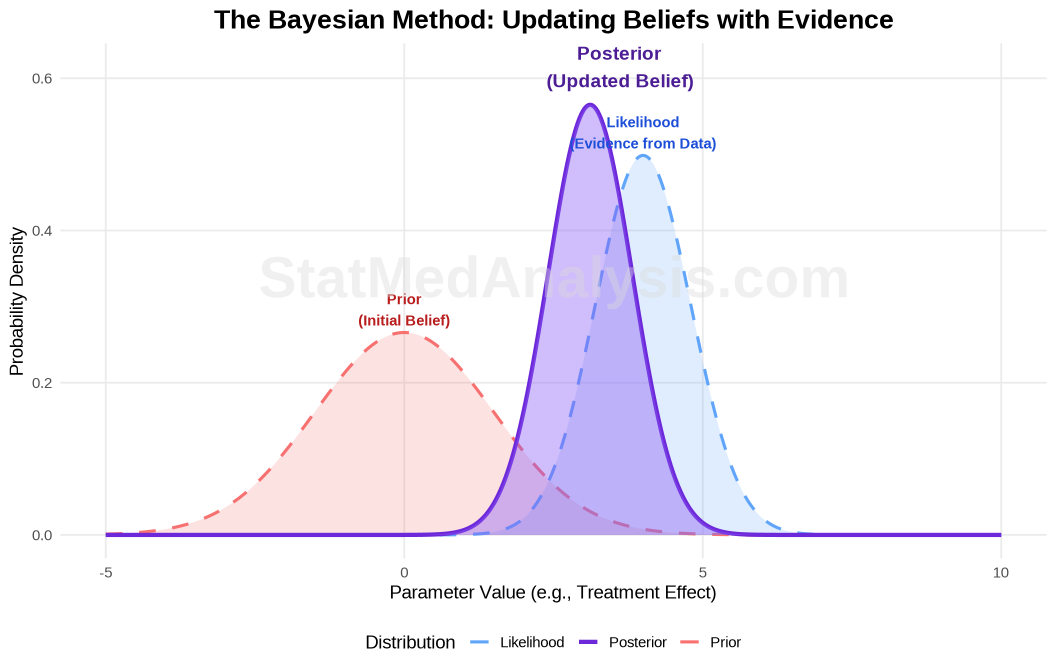
Illustrative updating, not patient results. The likelihood is scaled for display. The posterior comes from a normalized product, not an arithmetic average of the plotted curves. A precision-weighted average describes the posterior mean in a particular normal model; it is not a general rule for posterior distributions.
When prior evidence can help
Historical information may support borrowing when populations, endpoints, treatment delivery, and clinical practice are sufficiently comparable. Explain which studies were considered, including unfavorable evidence, and why each was included or excluded. Borrowing can improve precision, but a smaller new trial is not automatically justified. Incompatible historical evidence can distort the result. FDA's medical-device guidance discusses these considerations; its scope should not be generalized to every product or jurisdiction. FDA Bayesian guidance.
Small samples make prior assumptions especially consequential. Regularization may stabilize estimates, but it does not create information about unobserved patients or guarantee superior performance. Compare conclusions under defensible alternative priors and explain what the current data contribute.
Adaptive trials require design evaluation
Posterior or predictive probabilities can support prespecified stopping and adaptation rules. They do not automatically make a trial faster, safer, or more ethical. Evaluate the planned design through simulation: false-positive decisions, power, sample-size distribution, and stopping probabilities under relevant scenarios. Include scenarios where prior information conflicts with the new trial. A posterior probability threshold is not automatically a frequentist type I error rate. FDA Bayesian guidance, design evaluation.
A practical analysis workflow
Define the outcome and treatment effect before choosing a model. Document priors, likelihood, missing-data assumptions, decision thresholds, and sensitivity analyses. During development, examine whether the model generates plausible data; after fitting, investigate computational problems and discrepancies between predictions and observations. Preserve code, software versions, and the decisions that shaped the analysis. Bayesian work extends beyond calculating a posterior: model checking, validation, and computational troubleshooting are central parts of the process. Gelman and colleagues, Bayesian Workflow.
Report the posterior estimate and uncertainty alongside the clinical context. Distinguish the probability of any benefit from the probability of a benefit large enough to matter. Explain when conclusions change under alternative assumptions.
For a study-specific discussion, request a methods consultation or explore our study-design support.